Life Cycle Cost models
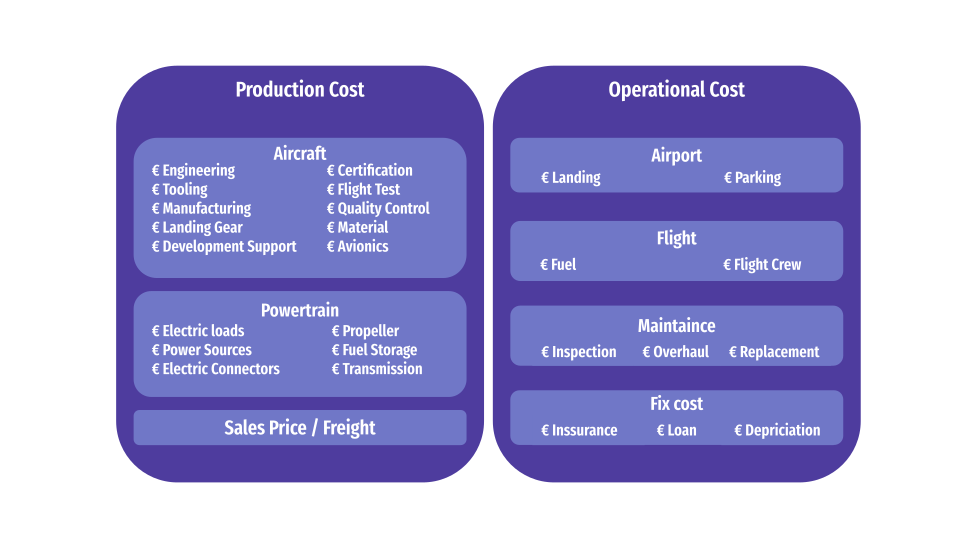
The Direct Operating Cost (DOC) of an aircraft can be broken in two main cost categories: the production cost and the operational cost. The contents of those two categories are detailed in the following descriptions.
Production cost model
The aircraft and the powertrain are the two main contributors to production costs. Aircraft production costs are calculated using the Eastlake model (1986) from [Gud13]. Powertrain component purchase costs are either based on the Eastlake model (1986) from [Gud13] or estimated from dealers or company websites. The cost calculations from [Gud13] are based on the USD in 2012. To account for currency depreciation, a cost adjustment factor \(CPI_{\text{2012}}\) is introduced. This factor represents the cost price index difference between 2012 and today.
Aircraft production cost
Cost of engineering, tooling, and manufacturing
The cost of the engineering labor, tooling labor, and manufacturing labor share a similar computation structure. It begins with estimating the total man-hours required for the development process for the first 5-year production period. Then, the cost is simply calculated by multiplying the number of man-hours (\(H_{\text{labor}}\)) by the labor cost rate (\(R_{\text{labor}}\)) for each subcategory, adjusted for inflation.
\(M_{\text{airframe}}\) is the weight of airframe, \(N\) is the number of aircraft produced in a 5-year period, \(V_H\) maximum cruise true airspeed in knots, \(Q_m\) is the estimated aircraft production rate per month, and \(F\) is the combination of factors based on aircraft design specifications detailed in [Gud13].
Learning curve reduction
As the manufacturing process matures with increasing production volume, both manufacturing and tooling man-hours are reduced. This reduction is modeled using a learning curve, characterized by a learning curve factor (\(x\)) and a resulting man-hour reduction factor (\(\phi\)). The learning curve factor is derived from the learning curve percentage (\(\theta\)), which typically ranges between 90% and 80% in aircraft production, as noted by [Bon17].
\(N_{\text{made}}\) represents the number of similar aircraft already produced by the manufacturer.
Cost of development support
The indirect development labor cost, provided by [Gud13], includes items such as overheads, administration, logistics, human resources, facilities maintenance during the aircraft development. As numerous types of labor are included, this cost cannot be estimated with a fixed cost rate.
\(N_p\) is the number of prototype produced during the development period.
Cost of flight test
The flight test cost, provided by [Gud13], includes items such as the cost of development and certification flight test.
Cost of quality control (QC)
The QC cost, provided by [Gud13], includes items such as the cost of manufacturing quality control, the cost of technicians and the cost of equipments.
\(C_{\text{MFG}}\) is the manufacturing cost on a 5-year period and \(f_{\text{comp}}\) is the proportion of the airframe made of composite material.
Cost of materials
The material cost, provided by [Gud13], computes the raw material purchase cost for the airframe.
\(F_{CF}\) is the complex flap system factor = 1.02 if complex flap system are used and \(F_{\text{press}}\) is the pressurized factor = 1.01 if the aircraft has a pressurized cabin.
Cost of certification
The cost of certification, provided by [Gud13], is the sum of engineering labor cost, development support cost, flight test cost, and the tooling labor cost.
Powertrain production cost
Engine purchase cost
The engine purchase cost calculation is obtained from [Gud13].
\(P_{\text{BHP}}\) is the brake-horse power of the internal combustion engine and \(P_{\text{SHP}}\) is the shaft-horse power of the turboshaft engine.
Propeller purchase cost
The propeller purchase cost calculation is obtained from [Gud13].
\(D_p\) is the diameter of the propeller and \(P_{\text{SHP}}\) is the shaft-horse power applied to the propeller.
Synchronous motor / Generator purchase cost
This unit purchase cost is obtained from regression model based on product retail prices of EMRAX.
\(P_{\text{max, cont.}}\) is the maximum continuous power of the motor / generator.
Battery purchase cost
The battery purchase cost is modeled with power regression from [CK23].
\(C_{2022}\) is the energy per dollar of battery in 2022, \(E_{bat}\) is the maximum energy supply from battery, and \(Y_{2022}\) is the number of years since 2022.
DC cable purchase cost
The purchase cost of DC cables is based on the metal material cost, non-metal material cost, and the gross margin (\(\Gamma_{\text{gross}}\)) of the cable manufacturing industry. The material cost assumption is detailed in assumptions.
Where \(n \in \{\text{core, insulation, shield, sheath}\}\)
Inverter/DC-DC converter purchase cost
The purchase cost of power electronics is obtained from regression model based on the retail price of MidContinent and other products suggested for the EMRAX electric motors.
\(P_{inv}\) is the inverter power rating and \(P_{con}\) is the converter power rating.
Rectifier purchase cost
The purchase cost of the rectifier is obtained from a linear regression with the maximum AC current (\(I_{AC}\)) and the retail price of ATO.
DC SSPC purchase cost
The purchase cost of DC SSPC is based on the price of IGBT modules from Semikron, the maximum current (\(I_{max}\)), and a price adjustement factor (\(k_{\text{SSPC}}\)) to account for price difference.
Operational cost model
Similarly to the production cost model, the operational cost model is also built by separating aircraft and powertrain costs. As the maintenance cost at aircraft level already includes the cost of the storage tank and gearboxes, their individual costs are not calculated separately. For all electronics, motors, and battery, the operational costs are estimated as an annual fraction of their purchase price.
These cost models are based on a regression derived from data from Guardianjet and PLANEPHD.
If the aircraft is fully or partially financed by loaning, the annual payback amount is estimated with the formula based on regular house mortgage from [Gud13].
\(P\) is the principal of the loan, \(R_{\text{interest}}\) is the annual interest rate, and \(n\) is the payback period.
The yearly insurance cost estimation as provided by [Gud13], a slight value adjustments is applied using values from Sunset aviation insurance.
\(Price\) is the purchase price of the aircraft
The aircraft landing and parking cost before VAT are obtained from Toulouse Blagnac airport.
MTOW (Tons) |
Daily parking cost (€) |
Landing cost per operation (€) |
|---|---|---|
\(MTOW \leq 1.5\) |
\(1.63\) |
\(31.8\) |
\(1.5 < MTOW \leq 2.5\) |
\(3.2\) |
\(41.13\) |
\(2.5 < MTOW \leq 6\) |
\(5.49\) |
\(55.29\) |
\(6 < MTOW \leq 7\) |
\(5.68 MTOW\) |
\(55.29\) |
\(MTOW > 7\) |
\(5.68 MTOW\) |
\(50.35 + 0.55(MTOW-6)\) |
Fuel cost estimations are obtained from [SNWK24] and Orleans loire-valley airport.
Fuel Type |
Unit cost (€/kg) |
|---|---|
Avgas 100LL |
3.36 |
Jet-A1 |
2.72 |
Diesel |
1.81 |
Pressurized Hydrogen |
6.1 |
The maintenance cost of the propeller, turboshaft, and internal combustion engine (ICE) is calculated as the annual portion of the overhaul cost, based on their time between overhaul and flight hours per year. The overhaul cost of propeller is provided by Aircraft accessories of Oklahoma.
Propeller Type |
Overhaul cost range ($) |
|---|---|
Fixed-pitch |
840 - 920 |
Constant-speed |
2800 - 3400 |
Constant-speed with turboshaft |
4000 - 6800 |
\(V_{\text{disp}}\) is the ICE piston displacement volume and \(P_{\text{cont}}\) is the maximum continuous power of the turboshaft engine at sea level.
Cost model structure
The following diagrams present the structure of the LCC model using the TBM-900 and Pipistrel Velis Electro as support.
LCC N2 diagram with TBM 900LCC N2 diagram with Pipistrel Velis Electro