Surface-mounted permanent magnet synchronous motor computation
This model represent a SM PMSM with non-salient radial flux and supplied with sinewave currents. This choice simplifies the modeling process while providing accurate representation of the PMSM characteristic. As in other PMSMs, the stator bore slots between adjacent teeth hold the wound cables, serving as the electromagnets. Unlike AF PMSM, the permanent magnets are mounted directly on the rotor’s outer surface rather than embedded within it.
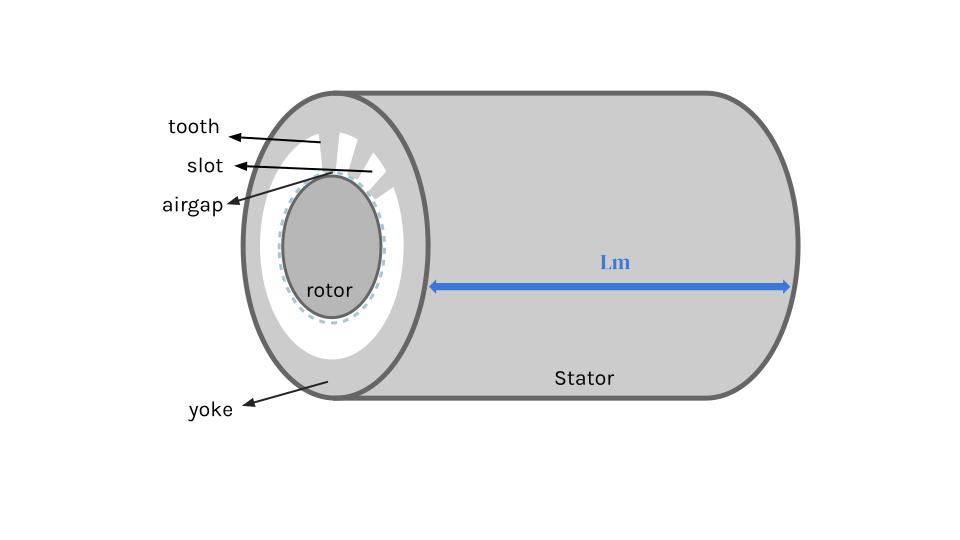
This figure, provided by one of the main thesis of HASTECS project [Tou20], demonstrates the essential geometric parameters of a SM PMSM. \(L_m\) is the length of the motor’s active electromagnetic part.
Performance calculation
Most of the performance calculations shares a similar approach as the AF PMSM model, except the losses caused by various factors. The three primary sources of losses in the Surface-mounted PMSM as modeled in the HASTECS project [Tou20] are presented below.
PMSM Joule losses
Joule losses represent the most important sources of losses in the SMPMSM. It is caused by Ohmic heating in the conductor wires winding of the PMSM stator. At low operating speeds, the current density is evenly distributed across the wire’s cross-section. To calculate the Joule losses, the wire resistance must be determined first.
Where \(N_c\) is the number of conductors, \(q\) is the number of phase in PMSM, \(T_{win}\) is the the temperature of the wire windings, \(\alpha_{th}\) is the electrical resistance coefficient of copper, and \(\rho_{cu20^\circ}\) copper density at \(20^{\circ}C\).
With the wire electrical resistance and the RMS current (\(I_{rms}\)), the Joule losses can be written as:
PMSM iron losses
As the second largest contributor to the PMSM performance losses, the iron losses arises from eddy current and the continuous variation of the magnetic flux. To better capture the behavior of the SM PMSM, a regression model using Least Squared Method by HASTECS project [Tou20] is considered.
\(B_m\) is the maximum magnetic flux density and \(f\) is the magnetic field switching frequency.
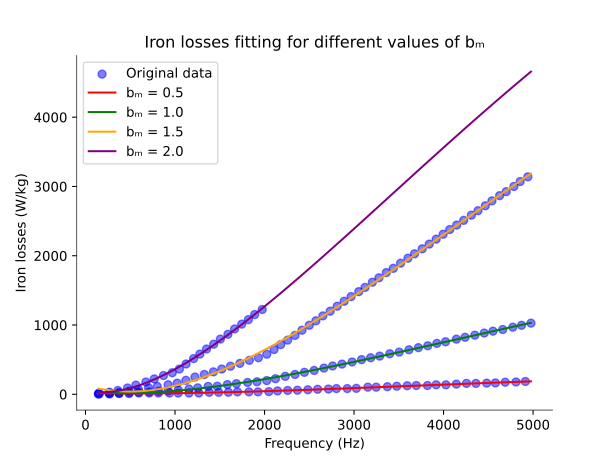
The iron losses coefficients (\(a_{ij}\)) are verified with empirical data provided by HASTECS project [Tou20].
PMSM mechanical losses
Mechanical losses (\(P_{mech}\)) are the consequence of various phenomenons including, friction between air and rotor or friction between a stationary solid and a rotating solid.
The two major windage losses (\(P_{windage}\)) result from the fluid friction between the air in the component gaps and the rotor. The airgap windage losses (\(P_{wa}\)) occurs because of the fluid friction between the stator and rotor while rotating. Similarly, the rotor windage losses (\(P_{wr}\)) arises from the space between both ends of the rotor and the motor casing. The rotor radius is denoted as \(R_{r}\), the shaft radius as \(R_{sh}\), the rotation speed as \(\Omega\), the air density as \(\rho_{air}\), and the motor length as \(L\).
Where the friction coefficient of airgap windage losses (\(C_{fa}\)) and the friction coefficient of rotor windage losses (\(C_{fr}\)) are:
\(e_g\) is the airgap thickness.
With the air pressure expressed as \(pr\), the air density (\(\rho_{air}\)) and the air dynamic viscosity (\(\mu_{air}\)).
And the Reynolds numbers for both losses are:
The bearing friction losses is another major contributor to the friction losses between a moving surface and a stationary surface. A simplified model for the bearing friction coefficient (\(C_{fb}\)) is provided for various bearing type based on SKF’s bearing datasheets [SKFGroup16].
Bearing types |
Friction coefficient \(C_{fb}\) |
|---|---|
Deep groove ball bearings |
\(0.0015\) |
Cylindrical roller bearings |
|
|
\(0.0011\) |
|
\(0.0020\) |
Spherical toroidal roller bearings |
\(0.0018\) |
CARB toroidal roller bearings |
\(0.0016\) |
Angular contact ball bearings |
|
|
\(0.0020\) |
|
\(0.0024\) |
|
\(0.0024\) |
Hybrid bearings |
– |
\(W_{rt}\) is the rotor weight, \(d_{bb}\) is the bearing bore diameter and the \(g\) is the gravitational constant.
Sizing calculation
In this sizing process, several geometry parameters related to the electromagnetic parts of the PMSM are simplified for a simpler model. The rotor is modeled as a single solid rod, omitting the bore layer and surface magnet sheets, with its material density defined according to the Etel TMB and TMK electric motor dataset from the HASTECS project [Tou20]. The slot geometry is modeled as a rectangle with no radial taper and without fillets.
SM PMSM dimension calculation
From the electric current balance and magnetic flux balance, the stator bore radius (\(R_{rt}\)), the active length (\(L_{m}\)), the conductor slot height (\(h_{s}\)), and the yoke thickness (\(h_{y}\)) can be derived.
\(\lambda = 2 R/L_m\) is the shape coefficient, \(\sigma\) is the tangential stress, and \(P_{em}\) is the given electromagnetic power.
Variable |
Explanation |
|---|---|
\(B_m\) |
Max airgap magnetic flux density |
\(K_m\) |
Max electric surface current density |
\(B_{st}\) |
Magnetic flux density in teeth |
\(B_{sy}\) |
Magnetic flux density in the yoke |
\(j_{rms}\) |
RMS current density |
\(p\) |
Number of pole pairs |
\(k_{fill}\) |
Cross section ratio between a slot and the wires in the slots |
\(k_{sc}\) |
Wire cross section ratio between straight cut and tilted cut |
\(k_w\) |
Wire winding coefficient |
\(x\) |
Radius ratio of the rotor radius and the stator bore radius |
SM PMSM weight calculation
The weight of the SM PMSM is the sum of the weights of all fundamental components, the stator core weight (\(W_{stc}\)), the stator winding weight (\(W_{stw}\)), the rotor weight (\(W_{rt}\)) , and the frame weight (\(W_{f}\)).
Variable |
Explanation |
|---|---|
\(N_s\) |
Number of the wire slots |
\(k_{tb}\) |
Cross section ratio between a slot and the wires in the slots |
\(k_{tc}\) |
Conductor wire twisting coefficient |
\(ls\) |
Slot width |
\(\rho_{stc}\) |
Stator core material density |
\(\rho_{stw}\) |
Stator winding (teeth) material density |
\(\rho_{c}\) |
Conductor wire material density |
\(\rho_{ins}\) |
Wire insulation material density |
\(R_r\) is the rotor radius and the \(\rho_{rt}\) is the rotor material density.
\(R_{fr}\) is the frame radius, \(R_{out}\) is the outer stator diameter, and \(\tau_r\) is the ratio of \(R_{fr}\) and \(R_{out}\).
Component Computation Structure
The following two links are the N2 diagrams representing the performance and sizing computation for the Surface-Mounted PMSM model.
SM PMSM performance N2 diagramSM PMSM sizing N2 diagram